Defiance
The pushback that may be protecting autonomy, safety, or dignity.
 Dr. David A. PalmerRewire the Response™For EducatorsSend Me the Toolkit
 The Six D's Decoder · Free 12-Page Toolkit
Decode six patterns of big nervous-system behavior, name what you're seeing, and choose your first move in the first 90 seconds, before it becomes the whole class's problem.
Send Me the Toolkit Instant download. No spam. Unsubscribe anytime.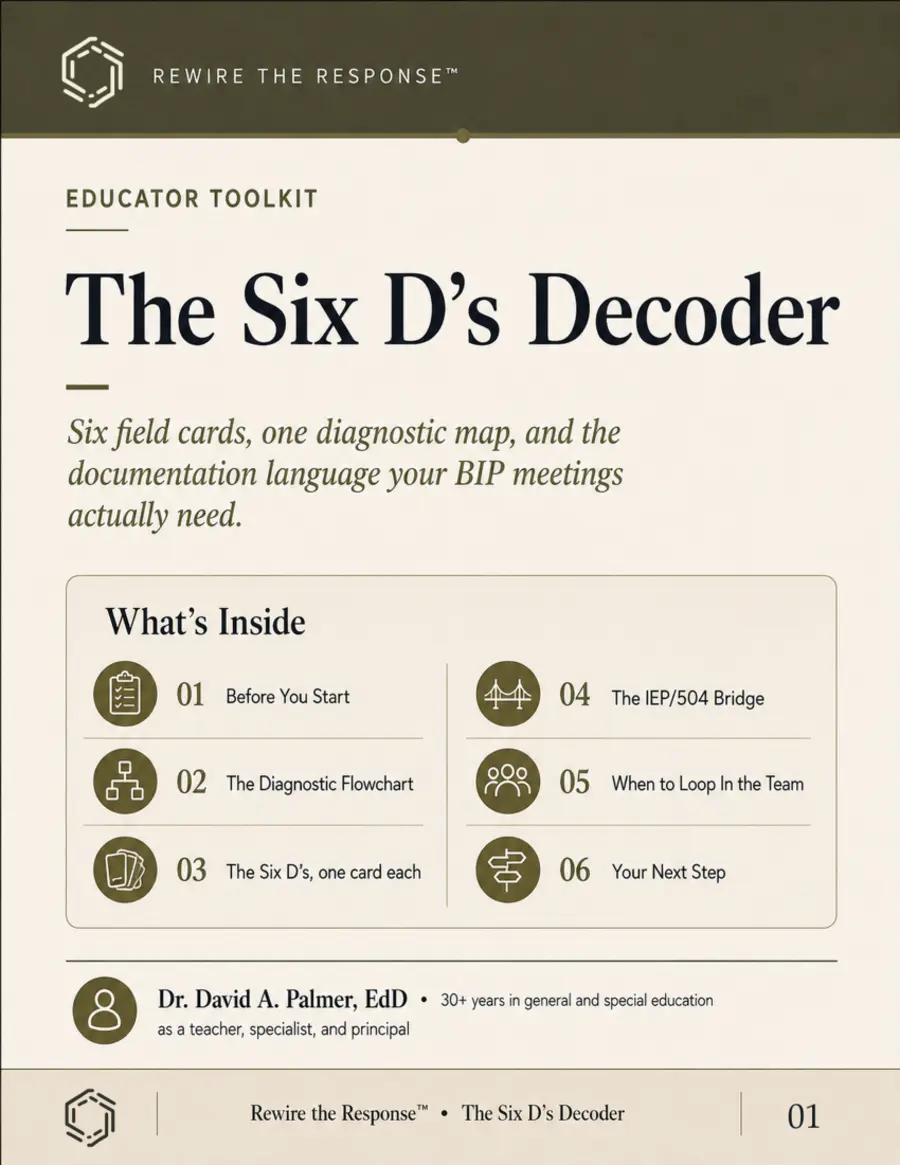
You already know the moment
A student goes from fine to detonation in front of the whole class. Maybe it looks like defiance. Maybe it's a kid going quiet and pulling a hood up. Maybe it's the one who clowns around every time a worksheet gets hard.
You've tried the chart. You've tried the warnings. You've tried staying calm and counting to three. Some days it works. Most days you're guessing, reacting, and hoping you guessed right, all while twenty-nine other kids watch you do it.
You can't consequence a nervous system into feeling safe.
Compliance strategies work on a regulated brain. When a student's nervous system flips into survival mode, a threat does not read as motivation. It reads as more threat. That is biology working exactly as designed, just not for the classroom you are trying to run.
The Six D's Decoder gives you another option. In the moment, not in a training six months from now.
Name the signal faster
The visible behavior is the starting point, not the verdict.
The pushback that may be protecting autonomy, safety, or dignity.
The noise or movement that may be seeking regulation or connection.
The escape pattern that may be protecting a student from overload or failure.
The visible explosion that signals the nervous system has exceeded capacity.
The shutdown or withdrawal that can be easy to miss and costly to ignore.
The fear, pain, or overwhelm that needs support before instruction can land.
What you get
The Six D's Decoder is a 12-page toolkit built for the classroom, not the staff lounge.
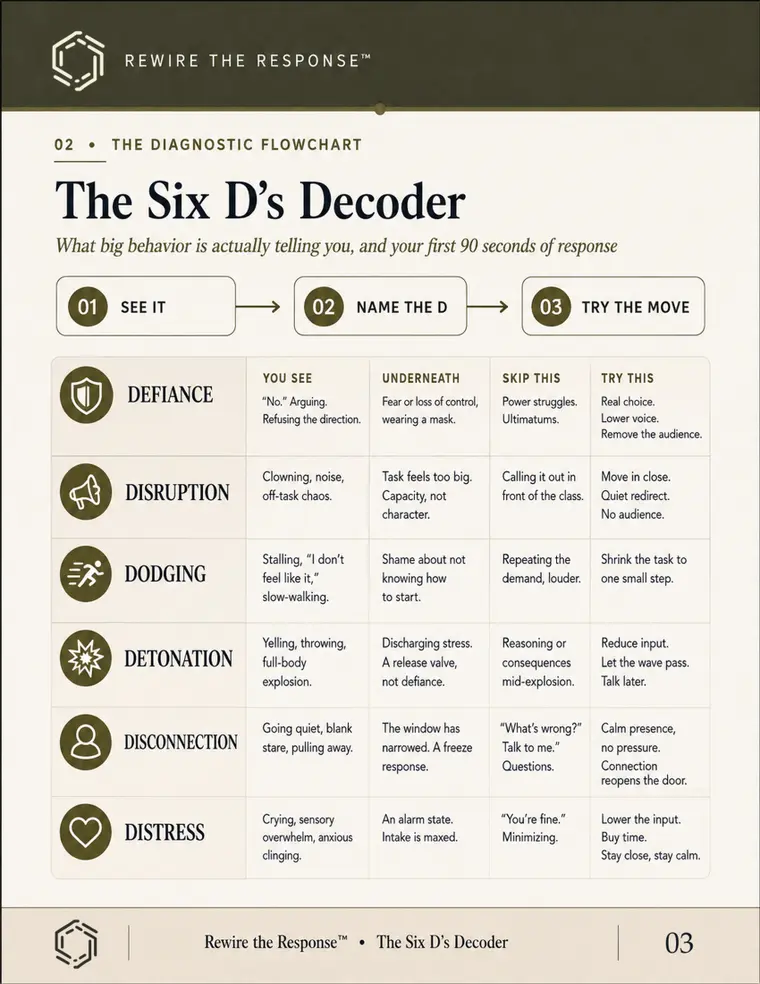
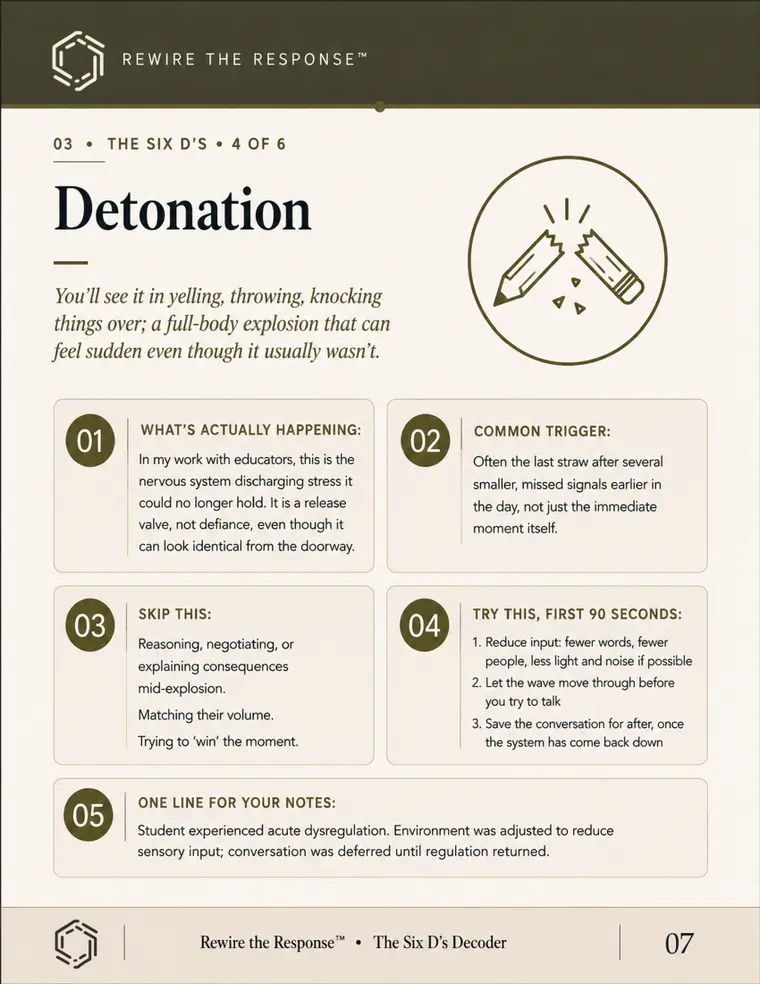
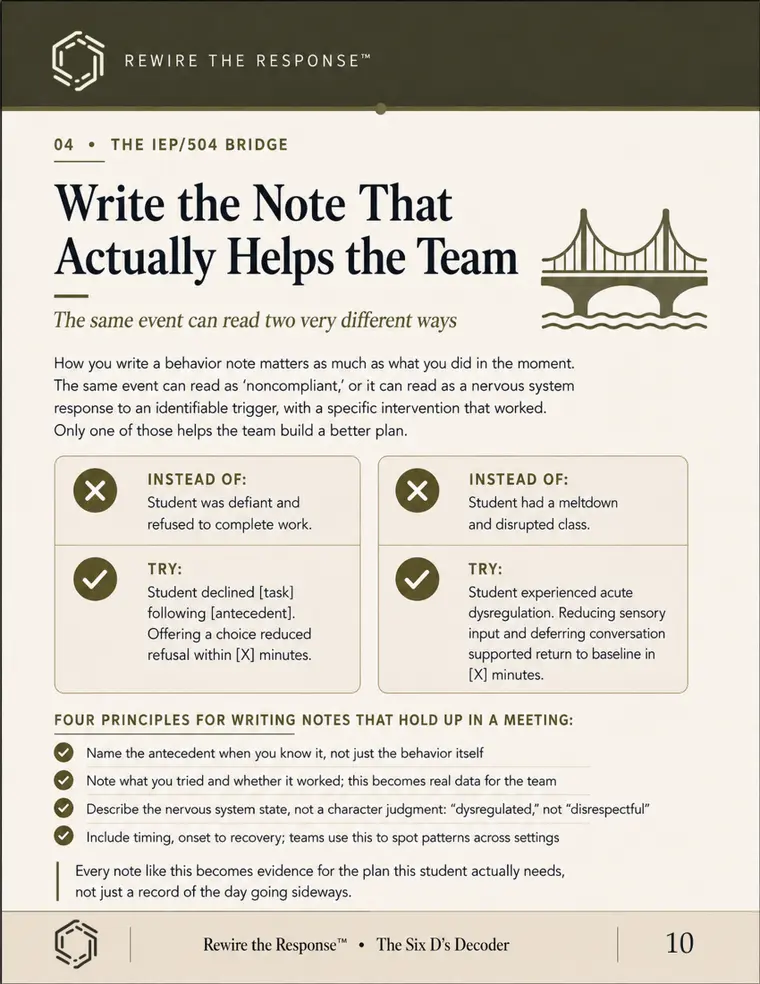
A real look inside. The complete, full-resolution toolkit arrives after you opt in.
One page, all six patterns, and your first move for each. Keep it open on your desk or phone.
One per pattern, with what it looks like, what may be happening underneath, what to skip, and what to try in the first 90 seconds.
A language shift that turns a behavior note into documentation that better supports the team.
Clear thresholds for recognizing when a moment is bigger than yours to carry alone.
A one-line documentation phrase on every card, so you are never starting from a blank cursor.
✓ Name which of the Six D's you are looking at in seconds, not minutes.
✓ Respond in a way that lowers the temperature instead of raising it.
✓ Write a behavior note that reads as data for the team, not just a record of the day going sideways.
Why this is different
It is built on the principle behind Rewire the Response: behavior is communication, not a character flaw, and the adult's regulation in the room is part of the intervention.
This is not abstract theory. It comes from real classrooms and real kids who blow past every consequence chart ever printed.
“You can't consequence a nervous system into feeling safe. It reduces the stress out of parenting and teaching, even at the most stressful moments. I noticed it improved my classroom environment and my home environment. There is more peace, and for that I am forever grateful.”
Straight answers
You are not meant to read this cover to cover. The flowchart is one page. Glance, name the D, try the move. The rest is there when you have five quiet minutes.
This is what to do in the ninety seconds before a chart, point system, or consequence has a chance to matter, because none of those work until the nervous system can hear them.
No. Every field card gives you a specific first move, not a vague mindset shift. “Be more patient” is not a strategy.
No single tool works for every student every time. This gives you a faster, more accurate read so your response has a real shot at working instead of being a guess.
The toolkit is free and complete on its own. If you want more later, that is your call, not a bait and switch buried on page six.
Frequently asked questions
A 12-page PDF you can keep on your desktop, print, or pull up on your phone mid-day. It is built to be legible at a glance, not just on a full screen.
No. It is built for any teacher in an IEP or 504 classroom, general education included, along with counselors, paraeducators, and behavior specialists who want a shared language with the classroom teacher.
The IEP/504 Bridge helps you write notes that read as usable data for the team. It is not a replacement for your district's documentation requirements or legal guidance, so use it as a starting language shift, not a compliance document.
If you have read The No. 1 Guide to Quick Wins, this goes deeper into one specific piece: the Six D's themselves, with a diagnostic and documentation tool built around them.
No. It is free and works completely on its own.
The flowchart takes under two minutes to read once. Keep it nearby for a few weeks and the patterns will start to feel more automatic.
Free educator resource
Enter your email and it will be in your inbox in under a minute.
Having trouble seeing the form? Open it in a new window.
Be ready for the next moment
Ninety seconds is not a lot of time. This toolkit makes sure you do not need more than that.
Send Me the Toolkit